


Unlocking the Mysteries of Disease Through Microgravity
- Lily Grudenic
- Dec 28, 2024
- 3 min read

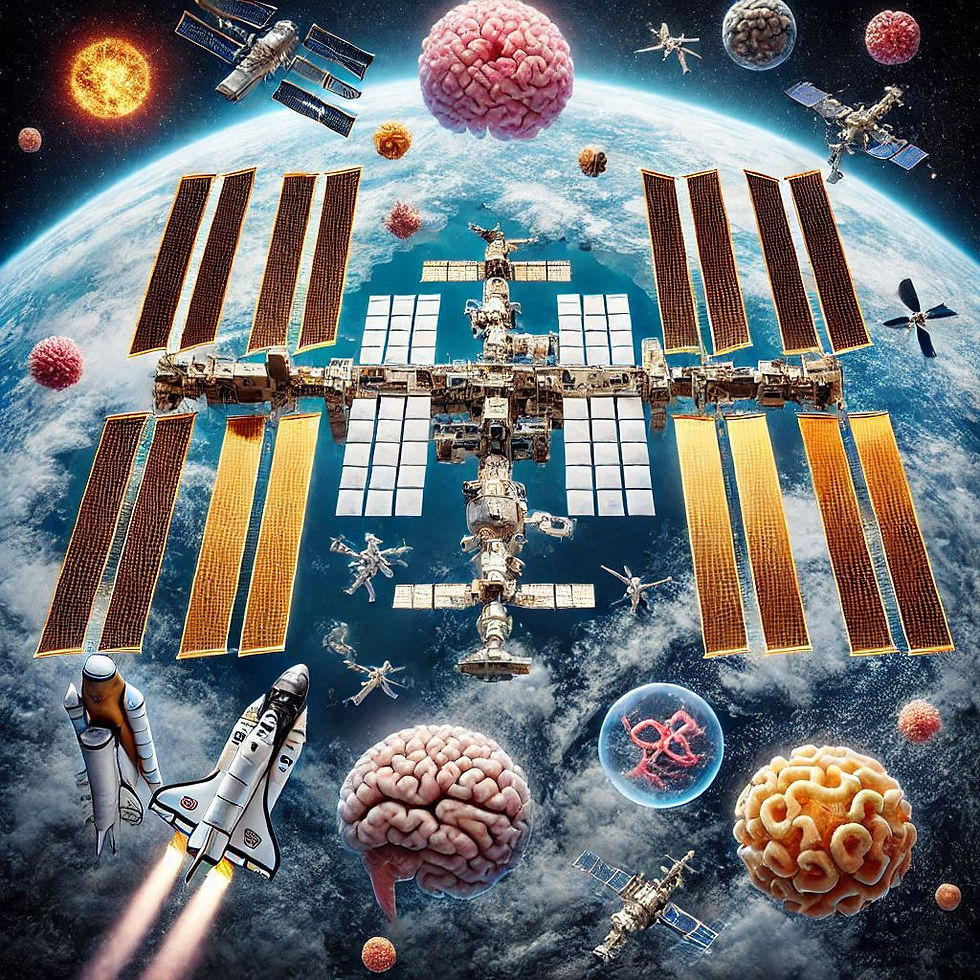
For over two decades, the International Space Station (ISS) has been a hub for groundbreaking scientific research, offering insights that are impossible to achieve on Earth. Among its most remarkable contributions is its role in testing the complexities of diseases like Alzheimer’s, Parkinson’s, cancer, asthma, and heart disease. Through experiments conducted in its unique microgravity environment, the ISS has transformed our understanding of these conditions and opened new pathways for medical advancements.
The Role of Microgravity in Disease Research
Gravity on Earth shapes nearly every aspect of biological processes, from how cells grow to how molecules interact. In space, the absence of gravity—or microgravity—removes this constant force, allowing scientists to observe phenomena that are otherwise masked. For disease research, this has been a game-changer, enabling unprecedented investigations into cellular behaviors and molecular mechanisms.
Microgravity acts like a magnifying glass, amplifying subtle processes that are difficult to study under Earth’s conditions. For example, proteins, the molecular building blocks of life, behave differently in space, often forming larger and more structured crystals. This clarity allows researchers to analyze diseases at a molecular level, leading to critical insights into their causes and potential treatments.
Alzheimer’s Disease: New Insights From Space
One of the ISS's most notable achievements is its contribution to Alzheimer’s research. At the heart of this disease are beta-amyloid proteins, which form plaques that disrupt brain function. On Earth, these proteins aggregate rapidly, making it challenging to study their formation in detail. However, in the microgravity environment of the ISS, researchers have observed beta-amyloid aggregation under controlled conditions.
These experiments revealed unique patterns in how the proteins interact, shedding light on the disease’s progression. The findings have guided the development of drugs aimed at preventing or reducing plaque formation, a key target in Alzheimer’s treatment.
Cancer Research in Space: Changing the Perspective
Cancer research aboard the ISS has similarly benefited from the absence of gravity. On Earth, cancer cells grow and interact with their environment in specific ways, influenced by gravity-driven forces. In space, these forces are removed, allowing scientists to study cell signaling and growth in a completely different context.
For instance, researchers discovered that cancer cells in microgravity exhibit changes in communication pathways, including signaling processes that drive tumor growth. By identifying these pathways, scientists have pinpointed new therapeutic targets, paving the way for innovative treatments that could inhibit cancer progression.
Collaborative Efforts Driving Innovation
These groundbreaking studies are the result of international collaboration. NASA, the European Space Agency (ESA), and the Japan Aerospace Exploration Agency (JAXA) have worked closely with universities, research institutions, and pharmaceutical companies to design and conduct experiments on the ISS.
Prominent scientists, such as Dr. Cheryl Nickerson, who has studied the behavior of infectious pathogens and cancer cells in space, and Dr. Daniel J. Wood, who led Alzheimer’s-related research, have played pivotal roles in these endeavors. Their work exemplifies how the ISS bridges space exploration and medical research to benefit humanity.
Advancing Our Understanding of Other Diseases
The ISS’s microgravity environment has also facilitated studies on other diseases. Research into asthma has explored inflammatory responses in microgravity, providing new insights into managing this chronic condition. Similarly, cardiovascular experiments have shed light on heart disease, revealing how fluid distribution changes in microgravity impact cardiovascular function.
A Unique Laboratory in Orbit
Experiments on the ISS take place in specialized modules, such as the U.S. Destiny Laboratory and the European Columbus module. These facilities are equipped with state-of-the-art tools that allow scientists to conduct experiments in real-time and observe how biological systems respond to microgravity. The ability to study diseases in this setting has revealed new aspects of disease mechanisms that are not apparent on Earth.
The Impact on Earth
The discoveries made aboard the ISS have had profound implications for healthcare on Earth. Insights into protein behavior and cell signaling have accelerated drug development, leading to more effective treatments for Alzheimer’s and cancer. Furthermore, these studies have deepened our understanding of how gravity influences disease progression, offering new strategies for combating degenerative conditions.
The ISS stands as a future of scientific innovation, proving that the unique environment of space can unlock mysteries that benefit life on Earth. Through its contributions to disease research, the ISS has not only advanced our knowledge of complex medical conditions but also demonstrated the value of international collaboration in addressing humanity’s most pressing challenges. As we look to the future, the ISS continues to inspire hope for new breakthroughs that could change the course of medicine and improve lives worldwide.


Comments